Camila Medina Novoa is a landscape historian and researcher, whose work sits at the intersection of history of landscape architecture, environmental history, history of science, and the emerging field of Plant Humanities — which places plant species at the centre of historical and cultural inquiry, allowing scientific and humanistic disciplines to inform one another. Co-founder of lofscapes, a Chilean collective dedicated to expanding public discourse on landscape, Medina Novoa is interested in transatlantic narratives and the ecological and cultural co-production of landscapes. Her doctoral research from ETH Zürich follows a single tree species, Araucaria araucana, from its native forests in southern Chile and Argentina into the ornamental gardens of Georgian and Victorian Britain. In tracing that journey, she unfolds the wider social, ecological, and cultural entanglements that shaped how nature was seen, classified, transplanted, and designed with — tracing how scientific enquiries reshaped views of nature and, through them, landscapes. She is currently developing her dissertation, Making Ornamental Trees, into a book.
The discussion openings draw from and partly summarise articles Medina Novoa shared: A Hardy Species: A Perspective on Climate from Araucaria araucana Cultivation in 19th-Century British Gardens, published in Earth Sciences History 45, no. 1 (2026), A Tree in a Pot in a Party, and ‘Civilized’ Pleasures in the Peruvian Amazon Circa 1830, and are accompanied by archival images, sourced by Camila.
UŠ: Hello, Camila. As you have knitted in your publications, the scientific and societal frameworks developed by the objective-truth seekers of the European Enlightenment have exerted a lasting influence on the globalisation and universalisation of aesthetic perception — of what a landscape should look like, what nature should yield, and what knowledge of it should resemble. The picturesque, which today is frequently condemned for the extractive and assimilatory logic it carries, contributed profoundly to the colonial project: it made certain landscapes legible as productive, improvable, civilisable; and others as wilderness awaiting transformation. Scientific inquiry, in its classical modern form, proceeded by disaggregation — by isolating objects, fixing their properties, and severing them from the contexts that gave them meaning. It seems we are now engaged in the difficult work of reassembly, under a different understanding of what relations between things entail. Yet the consequences of that original splitting are not reversible. Where, in your reading of this history, does this framework begin to work against itself, and what made that visible?
CMN: We cannot deny that the method of fragmenting, classifying, and naming nature in Western modern science has contributed in many ways to knowledge production. It allows us today, for example, to easily recognise unfamiliar species, to produce international collaborative research, and to undertake cross-geographical analyses, to give a few examples. I think that nowadays there is a growing tendency to declare this framework simply bad, but at the same time, we have to recognise that modern science has genuinely contributed to how we understand the world.
However, one of the key failures of this approach — addressed by decolonial studies and by philosophers and historians of the sciences — is precisely that this method of knowledge production, together with its specialised language and visual representations, was understood as the only means through which to approach the material reality of nature, and was imposed as universal. In other words, it assumed that the narratives, images, and measurements produced by this science were completely objective. As Lorraine Daston, Steven Shapin and Simon Schaffer, and others have explained, the idea that scientific authority and technologies of precision are unaffected by cultural context and therefore immune to political positions is a fiction. Following Donna Haraway’s reflections, site-specific thinking invites us to recognise our own subjectivity in the production of objective knowledge. Instead of erasing entanglements in order to approach nature, the idea is to recognise them and allow knowledge to emerge.
In the case of my research, building on observations made by the art historian Daniela Bleichmar on drawings from the Spanish expeditions of the late eighteenth century, I recognise how botanical drawings tended to construct a visual definition of plants as isolated individuals, affecting cultural and aesthetic approaches to trees. I propose that these images and mindsets conditioned the use of trees in landscape design, shaping Western urban and domestic landscapes until today.
As it is possible to see how fragmentation ruled cultural and aesthetic relationships with nature during the nineteenth century, it is also possible to trace relatively parallel efforts to systematise environmental phenomena. Coming back to your question, I would say that, before it started working against itself, fragmentation became insufficient for understanding the nature of things. Evolutionary theory and the development of the concept of ecology in the second half of the nineteenth century transformed fragmentary approaches to nature by introducing the factors of time and relationality into the formation of natural phenomena.
Within Europe, Alexander von Humboldt, of course, emerges as a key figure in this narrative, as a scientist observing and describing the relationships between temperature, altitude, and sun exposure and plant distribution, and consequently putting together pieces of this fragmented nature. He was not the only one, and not only naturalists like him were concerned with plant–place relationships. Horticulturists, including landscape gardeners and nurserymen, were also invested in the relationship between plants and their environment, learning from and contributing to this knowledge through experimentation in the garden. The fever for — and the technical capacity for — plant collection and transplantation, especially of exotic species, made environmental data even more relevant for practical horticultural purposes.
The question of what makes the crisis of fragmentation visible is very interesting. In nineteenth-century Europe, works such as The Geography of Plants by Humboldt, his drawing of Chimborazo, and the journals and paintings of Marianne North were sensitive to coexistence. For landscape gardeners, fascinated with taxonomic composition, the definition of styles, the popularisation of the collection of exotics in the domestic garden, and the disconnection from scientific thinking, the crisis came much later. And maybe that is why fragmentation feels almost irreparable in urban environments. This question, though, definitely deserves a longer reflection.

UŠ: Your work builds on a constellation of thinkers who have collectively reoriented how we might approach Nature, knowledge, and the living world — among them Donna Haraway, Anna L. Tsing, Andrew S. Mathews, John Dupré, and Nancy Cartwright. What they share, across their considerable differences, is a commitment to relationality: to situated, local processes that emerge from specific contexts, histories, and interactions rather than from universal laws applied from above. Cartwright proposes that nature itself is an artful modeller, reacting according to local situations rather than enacting fixed, deterministic general laws. Haraway insists that nature is not something stable and given, but an achievement among many actors, not all of them human, not all of them organic. For Dupré, living entities like trees are better understood as ongoing, intricate processes entangled with multispecies communities than as static objects with fixed characteristics. How do you understand landscape within this horizon, and what was the gap in existing approaches that drove you toward situated thinking as a research posture?
CMN: Landscape emerges, in this theoretical context, as a form of aesthetic relationship with nature; a nature, as you described, that is multiple, composed of complex entanglements, situated, and in constant transformation. Landscape, then, is the result of the interaction between physical and cultural fields, which are composed of systems with different influential weights, that result in interpretable events. Designing landscapes, in this sense, is defined by the way we understand and manage the interaction of those fields.
Situated thinking avoids universal conclusions. It values local knowledge and diverse cultural approaches and validates the agency of subjects other than white men. In my research, instead of focusing on a particular territory, nation, project, explorer, or gardener, I decided to work with a specific tree species from South America, the Araucaria araucana. This species was transplanted from Chile to London in 1795 and became popular in Georgian and Victorian times in the UK. Even though there were already published interesting books on the so-called Monkey Puzzle tree in the UK, I saw, as you said, a gap: authors defining the history of the species’ transplantation did not acknowledge the agency of the tree itself, nor did they try to acknowledge indigenous communities or Chilean actors. I wanted to approach tree agency not in a metaphorical way, and without romanticising socio-ecological relationships or elevating plant or people to the categories of heroes. So, I started by understanding the biology of the tree and how it was placing limits on or enabling horticultural practices to unfold. And only after that did it become evident how the species had developed a different cultural life in the UK. The gap, in other words, was not simply a missing chapter in the history of a tree. It was a missing posture — one that could hold together the biology, the culture, the colonial dynamics, and the indigenous presence without reducing any of them to a supporting role.
UŠ: You understand trees as actors shaping the landscape, moving through wind and animal dispersal, colonising new soils in slow choreographies largely invisible to human perception. Human-mediated plant migration, particularly during the 18th and 19th centuries, operated under the imperative of improving Nature: the cultivation of wilderness into commodified land, the objectification of plants through imperial transplantation, and the progressive dismantling of life-sustaining entanglements in the pursuit of universalism. The very process of objectification that made plant species movable — Linnaean classification, botanical illustration against white backgrounds, the reduction of morphological complexity — also obscured the entanglements that sustain life. As you research, it was not until the early 1800s that species interconnectedness, soil conditions, climatic factors, and even what Humboldt called the social organisation of species began to be considered, yet this did not substantially alter the view of plants as productive, horticultural, beautifying objects; if anything, it served to commodify plants and landscapes further. The native was at that point neither researched nor particularly valued. The exotic was novel, collectable, and exciting. Today, under the compounded pressures of climate disruption and accelerating urbanisation, we tend toward native species with what might be called ecological provision — though one might ask whether this tendency is genuinely different in kind from earlier instrumentalisations, or whether it represents a new form of the same logic. Can you trace the shifting valuation of native versus exotic across the 18th and 19th centuries, and set that history in relation to how these categories function today?
CMN: This is an interesting question. For me, it was a revelation to realise that the famous British gardener John Claudius Loudon understood British flora as composed of both native and foreign species, and that he offered a special status to non-native species in landscape design. Exotic trees, according to him, offered diversity to the picturesque, elevating a landscape to an art form. One of the main goals of his publication Arboretum et Fruticetum Britannicum, last published in 1844, was to promote the use of exotic species. He even says that it was the duty of the nation to appropriate and distribute these species. The aesthetic experience of what Loudon called modern gardening, or the gardenesque, was based on the exaltation of the eye and the mind. Being able to recognise species and becoming familiar with foreign ones was a sign of a cultured mind, reflecting that the observer had scientific knowledge. Cultivating exotics was also appreciated as a challenge. Landowners who were collectors and, of course, their head gardeners, needed to know about botany to succeed in keeping foreign species alive. Being, in other words, men of science.
Nowadays, things are different, and one of the main reasons, as you were saying, is ecological thinking — ecology as a science, but also as an aesthetic. In other words, ecology has changed the definitions of the pleasant landscape, transforming aesthetic values of certain techniques, design methods, and maintenance practices. In addition, lately, the climate crisis has also changed landscape approaches. In this sense, if maintaining exotic species means the irresponsible use of water resources, for example, it becomes less pleasant to the eye for the people who care about the environment.
The garden has always been the place of transplanted flora. What changes perhaps are the distance and the level of disturbance. Trees, shrubs and flowers are reorganised to offer a specific aesthetic experience, usually a pleasant one. Investing in maintaining these spaces is still a priority; the question is in what we want to invest now. What is the limit between let “nature” be and neglecting wastelands?
I experienced this directly when I was teaching in Santiago, a very dry city, becoming more extreme with the climate crisis. Students were already saying that an always-green lawn felt wrong, that you could see the amount of resources it consumed. And yet the wealthiest neighbourhoods still had their lawns, still a symbol of privilege. In Chile, for example, the álamo — the Lombardy poplar or Populus nigra var. italica, introduced from Spain — has been there long enough that people assume it is native. It is part of the classical image of the colonial and post-colonial landscape. You cannot simply remove it from the discourse of native and foreign without confronting what it means culturally. As Helen Anne Curry well puts it, the categories of the exotic and natural are flexible in our cultural imagination.
UŠ: From your reading on Arboretum et Fruticetum Britannicum I understand that Loudon, in promoting hardy species capable of growing outdoors, framed their cultivation as among the most patriotic of gardening efforts — suggesting that hardiness, and the capacity to thrive en plein air rather than only under glass, carried with it a possible democratisation of aesthetic pleasure, extending it beyond the private orangery into the park and the public garden. How do you understand the potency of trees in contemporary thinking, and their entanglement with landscape as a relational system rather than a visual category? And how does one’s research practice actually change when trees are treated as actors rather than objects — what does the Araucaria araucana reveal that a more legible case study would not?
CMN: Trees allow us to think of long ecological and cultural entanglements that transcend generations. Especially the Pewen (Araucaria araucana), the tree that I studied, allows us to relate to landscapes existing beyond human time. Not only because this species can live for around a thousand years, but also because a very close species from which it evolved shared the Earth with dinosaurs. The Pewen, through its systems of adaptation to fire, its character as a pioneer species, and its preference for volcanic soils, connects us with landscapes from other times and makes us aware of the weight of extinction. In a way, if we eradicate some species, we also make disappear historical sets of ecological connections.
Under this mindset, protecting and planting trees reveals a desire for landscape endurance and a commitment to continuing our relationship with them.
However, I would say that thinking of landscapes as relational systems does not mean erasing visual pleasure — it means making it less central or transforming the set of values that has defined that visuality according to this perspective. I notice that people are sometimes afraid to talk about aesthetics because it feels like placing beauty over ecology. I think that opposition is a false one — what we need is a shift in what we consider beautiful, and that shift is already happening, however unevenly.
When we understand trees as active agents, research reinserts the human into nature, allowing us to recognise histories of co-production over histories of human achievement.
In the case of my work, much in line with what is called microhistories, it helped me to revise the texture of broader historical events: to unfold social interactions, political relationships, transplantation technologies, learning processes, and to approach an early nineteenth-century sense of taste. For example, because the Araucaria araucana cannot be propagated by cuttings, the British had to travel to Chile to obtain the seeds, unfolding a series of social interactions.
There is an emerging research field called Plant Humanities, with which I got in touch when I was a visiting researcher at Kew Gardens and Royal Holloway University of London, that systematises the method of working from species, and which I think is worth trying. Personally, I like that the concept helps to connect different disciplines and allows scientific fields and the humanities to interact as equals.
Following a species also allowed me to be more experimental with archival sources — moving between the Lindley Library, the Victoria and Albert collections, and digitised historical newspapers in both Britain and Chile, searching under all the names the tree has carried: Pewen, Araucaria imbricata, Monkey Puzzle, and their various misspellings. Sometimes searching for the tree, I would find something else entirely — a painting, a social announcement — and from there a new thread would open.
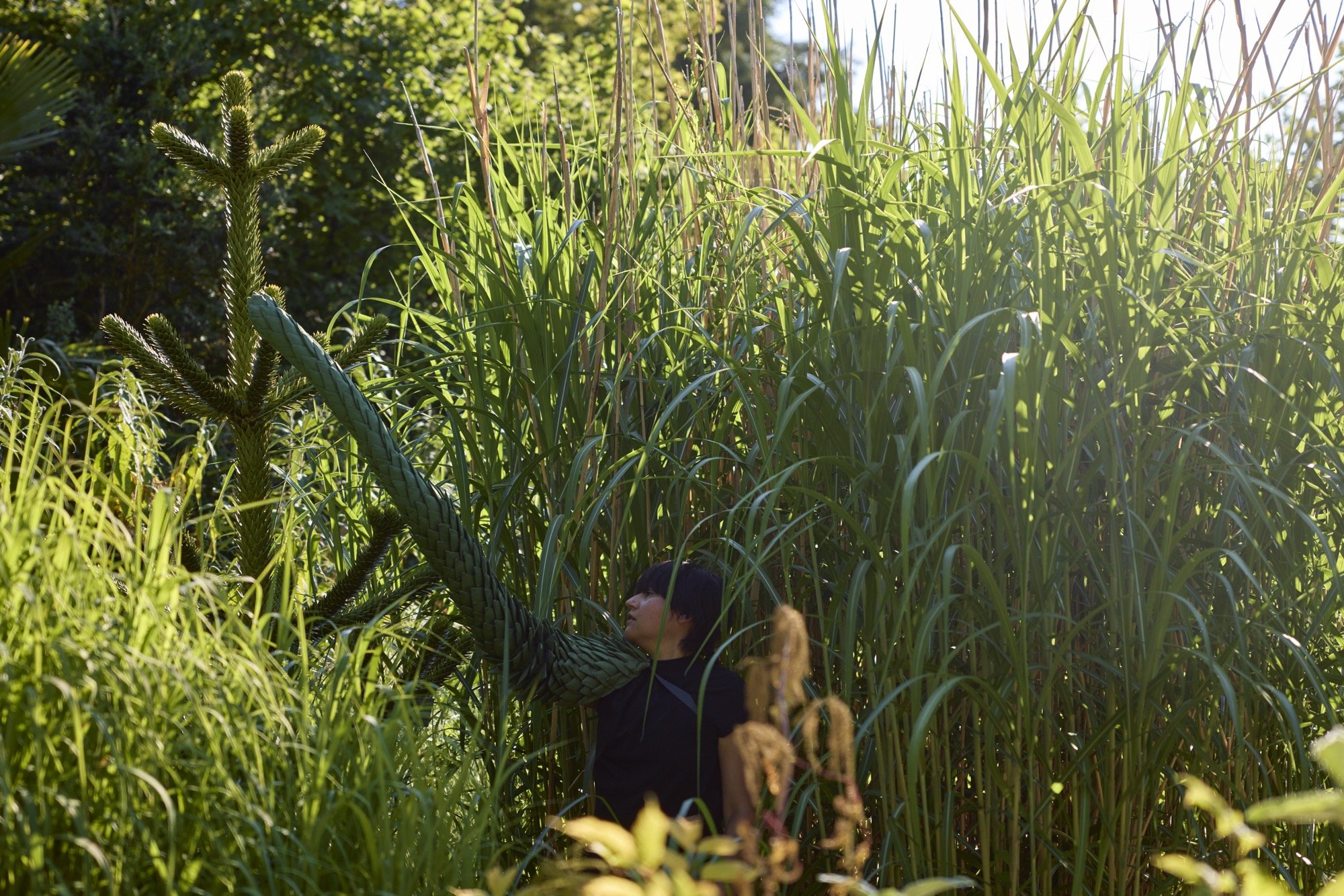
UŠ: In your article A Hardy Species: A Perspective on Climate from Araucaria araucana Cultivation in 19th-Century British Gardens, you examine a conifer native to southern Chile and Argentina — known as Pewen in Mapuzugun, Araucaria imbricata in 19th-century botanical nomenclature, and Monkey Puzzle in English — cultivated in Great Britain with considerable success as a hardy exotic. The tree carries a remarkable density of historical entanglements: it arrives in England through the pockets of a surgeon-botanist at a colonial banquet, its seeds likely handled by Mapuche people through diplomatic and trade relations; it becomes a Victorian status symbol, especially for its hardiness. In your conclusions, you propose that the concept of hardiness needs to be reconsidered in light of the contemporary climate crisis — expanding from individual specimen survival toward broader system resilience, shifting focus from isolated trees to the adaptability of forests and other landscapes as relational wholes. What does that shift demand in practice, from regulatory authorities, from landscape architects, from science?
CMN: It demands stopping the designing or regulating of individuals and instead addressing systems and communities. I think that scientists are already conducting studies that take into consideration the multiple entanglements affecting specific individuals, but I am not sure about urban and rural regulations. In this sense, the shift asks landscape architects to reassume their role as translators, learning from contemporary ecological, botanical, soil, and other sciences, and transmitting that knowledge to urban planners, politicians, and the general public. This translation can take the form of regulations, written texts, workshops involving the community, and landscape projects.
Teresa Galí-Izard, for example, has been doing precisely this kind of work, convincing local authorities in southern Chile to value the process over the image, the system over the result. I recommend checking her project “The Garden of the XXI Century,” especially the one in Tiltil.
UŠ: A final question, which perhaps opens more than it closes. Is Araucaria araucana capable of self-reproducing under current climatic conditions in Great Britain? The trajectory from hardy to invasive — from a species that survives in a new environment to one that spreads and establishes beyond the boundaries of any designed intention — has profoundly shaped our understanding of the limits of human control over Nature and of the genuine agency of plants as actors. The moment exotic species begin self-reproducing and dispersing beyond designed boundaries, the edges of the garden dissolve. The garden, understood as a managed threshold between the cultivated and the wild, is extended. Do you read that dissolution as failure, as a form of ecological success, or as something more ambiguous?
CMN: It is interesting to me that you asked that — I was very excited about this observation in the field.
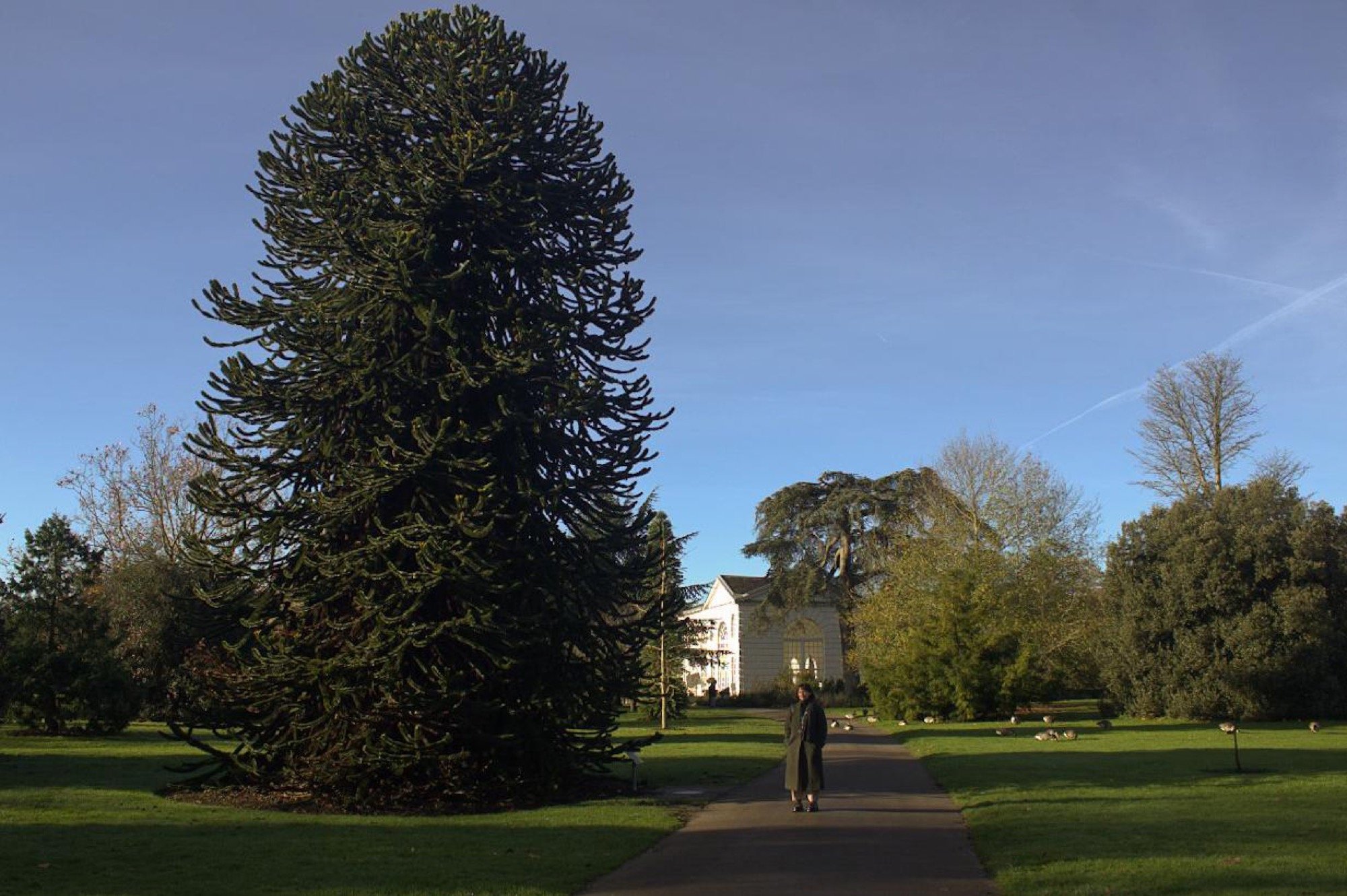
Usually, in gardens, these trees are planted in isolation, following the fashion of the nineteenth century. For reproduction, male and female specimens are needed for pollination to occur. Also, their pollen is relatively heavier in comparison with other conifers. This means that it is very difficult under those conditions to produce fertilised seeds.
However, you can see in some historical gardens old Araucaria araucana with suckers at the base. So, we could say that yes, the species can reproduce in gardens, at least in a vegetative way. However, many of these suckers are usually cut, and I have not witnessed the replacement of the mother araucaria in those situations.
Seeing those suckers was one of the most striking moments of the research. It felt like witnessing the tree doing something the garden had not planned for — gesturing toward the forest it cannot form. The suckers are cut because they draw energy from the mother tree, and the lawn mower takes care of the rest.
Species breaking the boundaries of gardens is, in some situations, definitely a concern that needs to be studied. That is why I think botanical gardens are very relevant as controlled centres of experimentation at a time when the climate crisis is moving plant zones and ecological floors.
As a Chilean, I find the idea of the world as a planetary garden complicated. I think of the forests of the south of Chile, of ecologies that are genuinely complex and not yet fully comprehended. The question is really about scale, and about who has the authority to decide what belongs where — and that authority has historically been anything but neutral.
Further read
Camila Medina Novoa, “A Hardy Species: A Perspective on Climate from Araucaria araucana Cultivation in 19th-Century British Gardens,” Earth Sciences History 45, no. 1 (2026): 27–45.
Camila Medina Novoa, “A Tree in A Pot in A Party,” Trans Magazin 46: Spolia (gta Verlag, 2025): 17–22.
Camila Medina Novoa, “‘Civilized’ Pleasures in the Peruvian Amazon,” gta Papers (gta Verlag, 2025): 84–96.