We spoke with Rania Ghosn about DESIGN EARTH, the studio she leads with El Hadi Jazairy, about pushing back against both techno-utopian and dystopian narratives, about a collective of women who “make a fuss,” and much more.
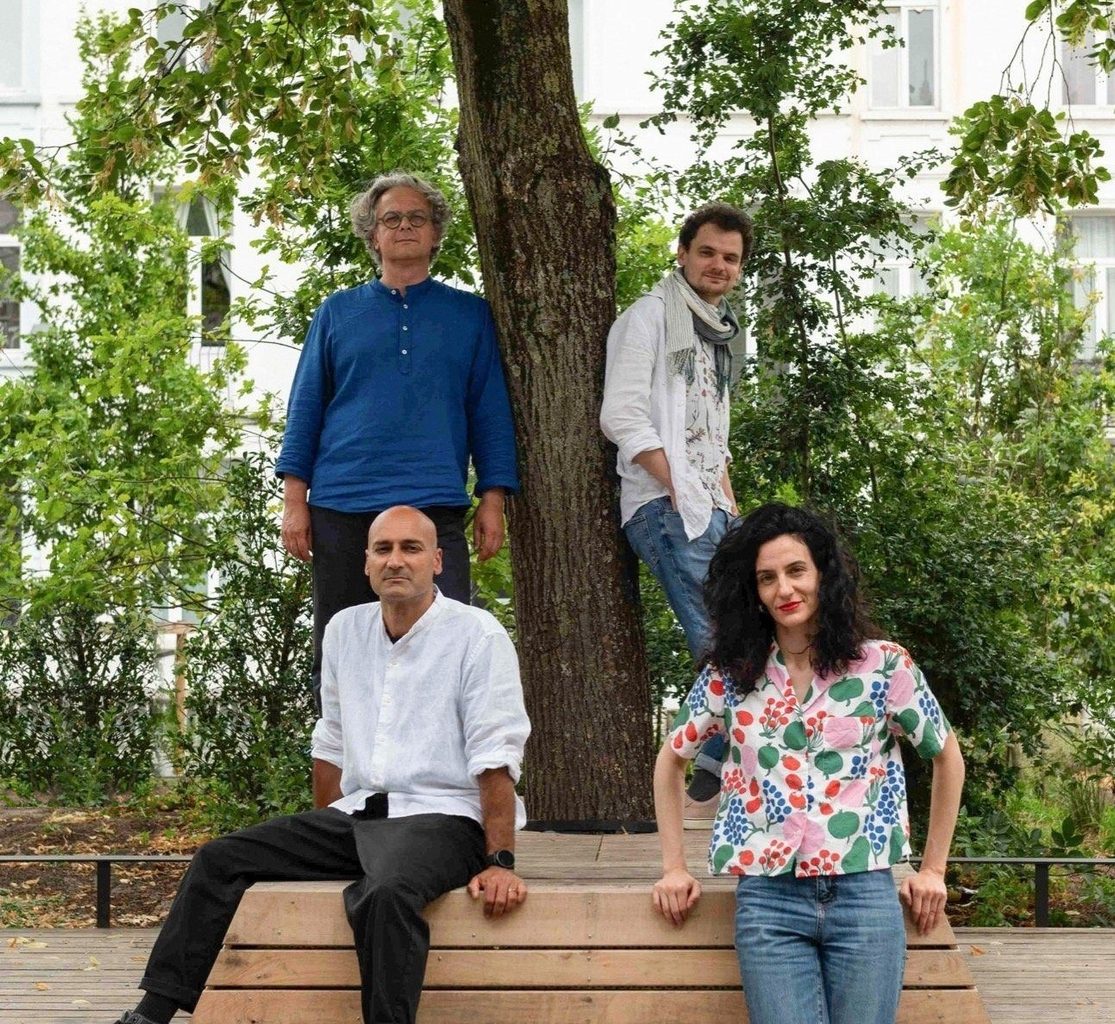
We spoke with four partners of taktyk, Thierry Kandjee, Sébastien Penfornis, Thania Sakellaroiu, and Simon Auperpin, about their work spanning more than twenty years, presented in an anthology they are launching this week at the IFLA World Congress in Hong Kong.
Landezine talks to Marcel Tröger of studio erde about polyphonic landscapes, the emerging aesthetics of the Anthropocene, and the need for landscape architects to work at a territorial scale. From ecological processes to the politics of water, he discusses how design can reveal hidden relationships and open space for dialogue.
Landezine talks to Mark Wigley about landscape as a form of human exceptionalism, the politics of soil, architecture’s long separation from microbial life, and why landscape design may now be one of the most politically charged fields of practice.
EXTERIORLESS is the term Corbo coined to investigate the condition of logistics infrastructures, a spatial byproduct that signifies the entanglement of capitalism and society. However gloomy, the analysis Corbo offers is meant as groundwork for action, not resignation.
We talked to Dermot Foley, an Irish landscape architect and founder of DFLA, about risk, reuse, ecological processes, working between the planned and the unexpected, and how their projects emerge from small things.
Phoebe Lickwar is an Associate Professor of Landscape Architecture at The University of Texas at Austin School of Architecture and director of FORGE Landscape Architecture, a practice working at the intersection of agriculture, carbon, and design. Her first book, Farmscape: The Design of Productive Landscapes (Routledge, 2020), co-authored with Roxi Thoren, is a study of […]
Landscape architects are rarely funny, argues Alex Breedon (Offcuts), and their humour rarely seeps into the work itself. This op-ed traces why that is, from professional caution to fear of frivolity, and makes the case for laughter as a serious tool for processing grief, protest and absurdity.
Annemarie Bucher teaches Landscape Theory and History at ETH Zürich. Here, she shares insights on critical reading of landscapes and new approaches to landscape historiography.
Interview with Billy Fleming on landscape architecture’s service to capital and what design could become in a just postcarbon transition: moving beyond heroic projects toward public ownership, community power, land justice and political action.
Medina Novoa is interested in transatlantic narratives and the ecological and cultural co-production of landscapes. Her research follows a single tree species, Araucaria araucana, from its native forests in southern Chile and Argentina into the ornamental gardens of Georgian and Victorian Britain, unfolding the wider social, ecological, and cultural entanglements that shaped how nature was seen, classified, transplanted, and designed with.
“There may have been fogs for centuries in London … But no one saw them, and so we do not know anything about them. They did not exist till Art had invented them.” — Wilde, Oscar. “The Decay of Lying.” In Intentions. London: James R. Osgood, McIlvaine & Co., 1891. “I like to think that […]
The Australian practice OFFICE recently published the book Aqua Nullius: First Nations Water Rights in Australia. The book presents a rich cross-section of Aboriginal culture and struggle for land and water rights through chapters on Storytelling, Water Injustice, First Nations Water Management and Overturning Aqua Nullius. Title, inspired by Virginia Marshall’s Overturning aqua nullius: securing […]
Sea-level rise caused by anthropogenic climate change poses an existential threat to coastal cities worldwide. By 2100, the IPCC projects a global mean sea-level rise of between 0.3 and 1.0 metres under moderate scenarios, with some estimates reaching 2 metres under extreme conditions, given Marine Ice Cliff Instability in Antarctica and accelerating melt dynamics in […]
In the article we search for landscape architecture projects that resist the temptation of resigning control or creating spectacle. Environmental stoicism – working with existing conditions proves productive force in design approach.
Recently, a case of a huge pink rabbit lying ‘dead’ in a mountainous terrain circulated on social media. The odd situation caught our attention. Hase by Gelitin produces a defamiliarising effect on the landscape — the body of a dreamy vernacular landscape is invaded.
The forest has recently become a site of renewed interest — not only in philosophy and the humanities, but also in art and aesthetic theory. Many reasons lie behind this return, all closely tied to the tensions of our present moment. We speak with philosopher and co-editor of Forest Encounters, Mateja Kurir.
Jürgen Weidinger on the pressures shaping landscape architecture today — from climate anxiety and public budgets to design culture and the next generation, and where the ways forward might be found.
Topophilia, the affective bond to place, presumes duration through which meaning accumulates. Under accelerating transformation, places are altered, degraded, or erased. Design, we argue, cannot produce places, it can only frame conditions where it may emerge and allow for attachment, not secure it.
We talk to Stephen Buckle about drawing as a thinking tool, landscape as urban system rather than surface, negotiating development pressures, rejecting fixed styles in favour of place response, and why landscape architects must take a stronger leadership role in shaping dense cities.
Anti-render flips the golden-hour fantasy. What if your project is seen on a grey November Tuesday instead of a May evening? A look at AI tools that strip away atmosphere and expose what design really stands on once people, light and seasonal charm disappear.
Žiga Malek on Natural Climate Solutions: their mitigation potential, limits, and land-use trade-offs, on how ecosystem protection, not tree planting alone, offers major benefits but cannot replace fossil fuel cuts, and how effective climate action requires systemic changes and realistic land use.
An interview with PAN Associati and EMF on the LILA 2025-winning Parco della Pace. Born from a former military airfield in Vicenza, this “non-muscular” design uses soil movement and groundwater to create a low-cost, 65-hectare landscape that prioritizes ecological processes.
Robert Schäfer and Urška Škerl speak to Mechtild Rössler about the evolving World Heritage Convention. They discuss the defining threat of climate change, the imbalance of the World Heritage List, and how landscape architecture—through “sponge city” concepts—can protect global heritage.
Air traffic has undergone significant changes since it became available to a wider population. The commercialisation of air travel, supported by reduced costs and technological development, increased the size of passenger terminals and the overall footprint of airports, driving urban and infrastructural transformation. At the same time, the life cycle of an airport is unpredictable, […]
Despite local initiatives to preserve industrial heritage and Ravenna’s iconic skyline, the Hamon towers, featured in Red Desert were demolished to make way for a government-supported photovoltaic power plant. Is demolition justified and have the Hamon towers, and what they stand for in the film, contributed to their demolition as part of a corporate profile-changing gesture?
In this article, we turn to Edward O. Wilson’s Biophilia (1984) to argue that biophilic design is central to landscape architecture, yet not as the imitation of natural forms, which has become common in architecture, but in the deeper sense Wilson describes as the “innate tendency to focus on life and lifelike processes”. Throughout the […]
Playful Pedagogies: Climate Change as a Game advances play as a mode of teaching and as a way for children and students to engage with landscapes under pressure. Entrapped in existing worlds and unable to let go of the known, how can children and students teach us, or, what would a cow have to say? We must admit it is not easy to shift to such a perspective.
In the article, we outline several contemporary epochal currents which, in a kind of singularity of collapse, may converge in what has been termed the Homogenocene, “a label for the modern world, characterized by unprecedented, and accelerating, flows of people, pests, crops, and forms of political domination”, as Charles Mann describes it, tracing its origins to 1493.
The COP30 in Brazil starts today. Felixx developed a catalogue for NBS, presented at COP26. Michiel Van Driessche reflects on the role of landscape architects in global policymaking, and what it means to translate climate goals into tangible strategies — from the Amazon to Groningen.
The decline of ‘ecosystem services’ implies a trajectory of increasing dependence on human-engineered substitutes. Zed Nelson’s photobook The Anthropocene Illusion shows simulations of experience of nature, mirroring lost ecological functions.
Streets are possibly the most complex public spaces to design. By definition, they are non-rivalrous and non-exclusive public good, granting accessibility to all. Pedestrians, cyclists, public transport, cars, fire and emergency trucks, deliveries—all stake competing claims on the same limited surface. Streets are designed under the highest constraints, yet must provide for everyone.
Between 17 and 21 November 2025, the 13th International Landscape Biennial of Barcelona will take place under the motto Natural Intelligence. Since its beginnings in 1999, the Biennial has become one of the most significant international platforms for landscape architecture — a space where practice, research, and education converge. We spoke with Marina Cervera, executive […]
BOGL are the recipients of the 2025 LILA Office Award. They operate from offices in Copenhagen and Oslo with a steady focus on the shared grounds of urban life. Rather than seeking signature forms, the practice has built its reputation on attentiveness — to site conditions, to communities, to the long horizons of climate change, […]
Multispecies Urbanism (MU) concept proposes that cities be designed and governed for the multispecies whole. In her manifesto, artist, infrastructure activist, and researcher Debra Solomon argues that healthy urban environments for humans are inseparable from the flourishing of other species and their microbial consortia. MU treats ecological labour—cooling, water buffering, pollination, soil formation—as infrastructural work […]
In this article, we enter into a conversation with Danilo Milovanović (DNLM), an artist based in Slovenia, whose practice in public space leaves behind socio-political and environmentally engaged commentaries. His interventions open up civic debate and make visible the tensions that shape contemporary urban life. Trained in the visual arts, Milovanović positions his practice outside […]
In the U.S., lawns cover nearly 2 percent of the land surface and, as researcher Cristina Milesi revealed using satellite data, “could be considered the single largest irrigated crop in America”—their total area is three times larger than that of irrigated cornfields. The infatuation with lawns runs so deep that, in some cases, failing to […]
Tempelhofer Feld, one of Europe’s largest urban open spaces, has long been a focal point of debate, particularly since its closure as an airport in 2008. Over the years, the site has sparked public protests, legal disputes, and heated discussions about its future. Now, after a highly anticipated international competition, the winning proposals have been […]
Anna Thurmayr and Dietmar Straub, operating from Winnipeg, Canada, approach landscape architecture less as a matter of monumental authorship and more as a form of quiet insurgency. Their practice resists spectacle, embracing instead small yet resonant gestures, collective processes, and deep attentiveness to context—whether planting 20,000 crocuses into a lawn or constructing an ephemeral Snow […]
Lars Hopstock’s Idyll and Ideology: Hermann Mattern and the Landscape to Live In is a heavy-lifter historiographic study. Published by Jovis in 2024, the volume arrives as a carefully crafted and tactile artefact in Jagd style, with hunting-green viscose-flocked covers reminiscent of a mounted trophy. Indeed, Hopstock has ventured deeply into archival “woods”, emerging with meticulous evidence and nuanced narratives around Hermann Mattern (1902–1971), one of Germany’s most significant yet contentious landscape architects. His expansive research not only sets the bar incredibly high for any similar undertakings but vividly frames Mattern’s navigation between aesthetic idyll and loaded ideology.
Led by James A. Lord and Roderick Wyllie, Surfacedesign, Inc. is a San Francisco–based landscape architecture and urban design studio known for bold, material-driven work that blends architectural clarity with a sculptural, site-attuned sensibility. From public parks and international airports to intimate gardens and experimental studios, their projects push against the conventions of globalised sameness, […]
The 2025 edition of the Biennale d’Architecture et de Paysage (BAP!) is taking place in Versailles from May 7 to July 13. This third edition, titled “The Living City”, focuses on preserving life in all its forms amidst climate disruption and dwindling resources. It aims to open new perspectives and sharing of knowledge and innovation […]
Lucia Tozzi is a Milano-based journalist and urban researcher known for her incisive critiques of gentrification, tourism-driven development, and the commodification of public space. Her writing spans cultural criticism, investigative reporting, and political analysis, appearing in publications such as Il Tascabile, NERO, Altreconomia, il manifesto, and other journals. She is the editor and author of […]
Dr. Anette Freytag is a relentless researcher, moving between academia, activism, and public engagement. She taught at ETH Zurich, the University of Basel, and the Technical University of Innsbruck before joining Rutgers University, where she is the Professor of the History and Theory of Landscape Architecture at the School of Environmental and Biological Sciences. Freytag […]
The volume On the Side of Fire. Rites, approaches and cultivation practices in landscapes is the twenty-first edition in the “Memorie” series by the Fondazione Benetton Studi Ricerche (FBSR), a Treviso-based international centre for landscape studies and research, founded by Luciano Benetton in 1987, focusing on history, geography, natural and cultural heritage. Opening space for […]
The Landscape Architecture Europe Foundation (LAE) has published the 7th edition of its book series, titled Full of Life. With each issue released triennially, the editorial board delves into high-quality landscape architecture projects, tracing the evolution of this young profession and highlighting the significance of addressing climate and social issues while crafting beautiful spaces. The […]
The book, Thinking Through Soil: Wastewater Agriculture in the Mezquital Valley, by Montserrat Bonvehi Rosich and Seth Denizen, came out last week, published by Harvard University Design Press. It is an enormous study, partly conducted through the Thinking Through Soil studio course at the GSD, Department of Landscape Architecture, and with the help of the […]
The first parks open to the public in Western society date back to the late 18th century, with the Englischer Garten in Munich (1789), named by the renowned Friedrich Ludwig von Sckell, followed by Maksimir Park in Zagreb (1794). Birkenhead Park, described as a “People’s Garden” by Olmsted and designed by Joseph Paxton in Liverpool […]
To provide the best experiences, we use technologies like cookies to store and/or access device information. Consenting to these technologies will allow us to process data such as browsing behavior or unique IDs on this site. Not consenting or withdrawing consent, may adversely affect certain features and functions.
Functional
Always active
The technical storage or access is strictly necessary for the legitimate purpose of enabling the use of a specific service explicitly requested by the subscriber or user, or for the sole purpose of carrying out the transmission of a communication over an electronic communications network.
Preferences
The technical storage or access is necessary for the legitimate purpose of storing preferences that are not requested by the subscriber or user.
Statistics
The technical storage or access that is used exclusively for statistical purposes.The technical storage or access that is used exclusively for anonymous statistical purposes. Without a subpoena, voluntary compliance on the part of your Internet Service Provider, or additional records from a third party, information stored or retrieved for this purpose alone cannot usually be used to identify you.
Marketing
The technical storage or access is required to create user profiles to send advertising, or to track the user on a website or across several websites for similar marketing purposes.