Participatory processes describe modes of design and governance that incorporate multiple voices, particularly those of users, residents, or marginalized groups. et participation often operates within asymmetrical power structures, where inclusion may mask pre-scripted outcomes. In landscape and architecture, such processes can generate collective ownership, but also risk becoming tokenistic rituals of consultation. Their value lies in exposing the politics of who is allowed to shape space.
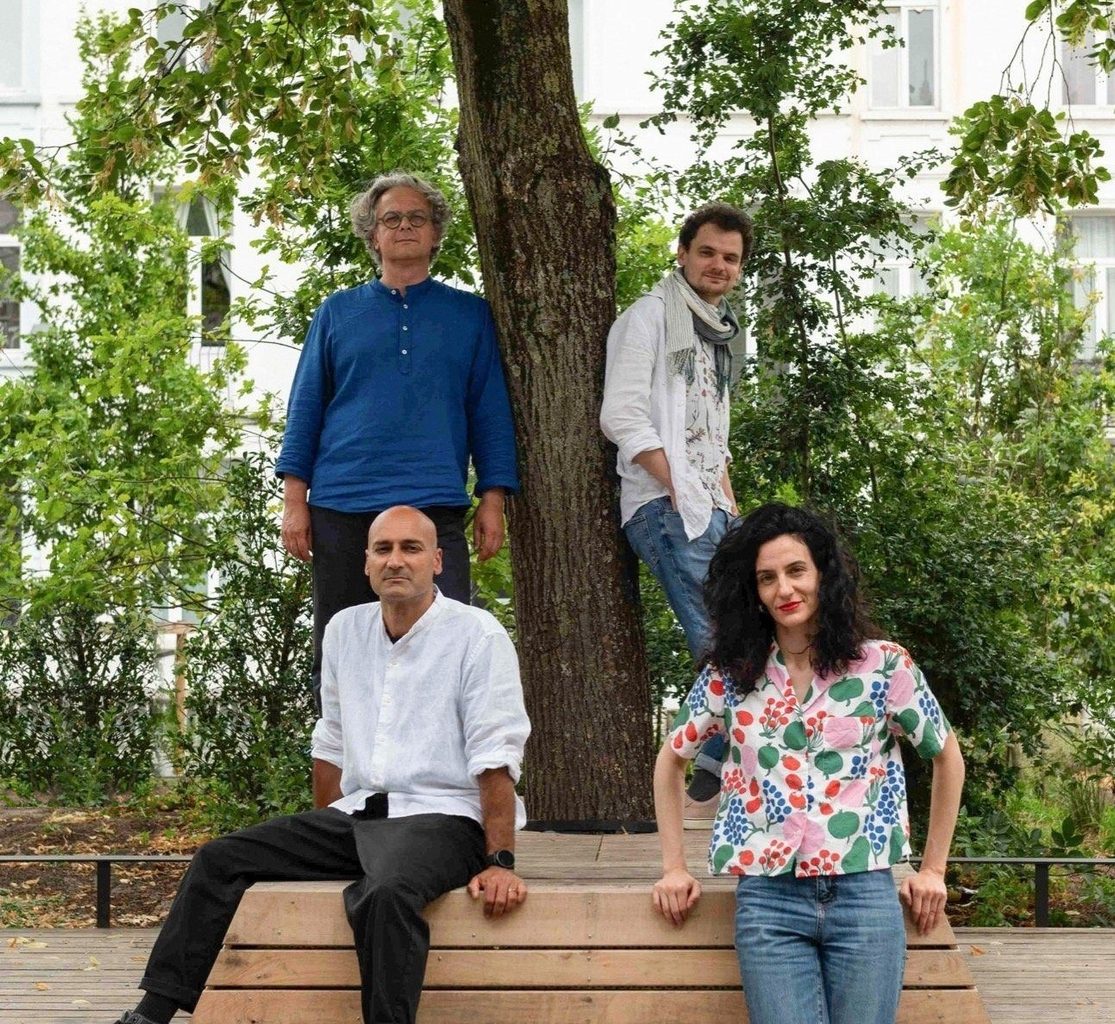
We spoke with four partners of taktyk, Thierry Kandjee, Sébastien Penfornis, Thania Sakellaroiu, and Simon Auperpin, about their work spanning more than twenty years, presented in an anthology they are launching this week at the IFLA World Congress in Hong Kong.
Landezine talks to Marcel Tröger of studio erde about polyphonic landscapes, the emerging aesthetics of the Anthropocene, and the need for landscape architects to work at a territorial scale. From ecological processes to the politics of water, he discusses how design can reveal hidden relationships and open space for dialogue.
Annemarie Bucher teaches Landscape Theory and History at ETH Zürich. Here, she shares insights on critical reading of landscapes and new approaches to landscape historiography.
“There may have been fogs for centuries in London … But no one saw them, and so we do not know anything about them. They did not exist till Art had invented them.” — Wilde, Oscar. “The Decay of Lying.” In Intentions. London: James R. Osgood, McIlvaine & Co., 1891. “I like to think that […]
Maria Goula is Professor of Landscape Architecture and department chair at Cornell University. She is a licensed architect and landscape architect, holding a PhD with a focus on Landscape Design Theory. Before joining Cornell, she taught and practised professionally for over twenty years in Barcelona, Spain. Since 2000, she has been a founding member of […]
Krater includes no landscape architects and follows no formal landscape architecture plan. Yet it is an intervention in landscape that stands as a provocative inquiry into the status of abandoned plots embedded within the urban fabric. The project poses fundamental questions: is a site truly ‘neglected’ if a thriving biotope has already taken hold? Could such a space, in its self-organized vitality, already constitute a form of an urban park? How to organize the social dimension? Krater unfolds as an expedition into landscape itself—an open-ended investigation in which fragmented architectural elements function as instruments of observation, experiment, and reflection. The site operates as a living laboratory, challenging conventional practices of open space production and the disciplinary boundaries of landscape architecture. It addresses relevant uncertainties the Anthropocene entails, engaging critically with issues of multi-species coexistence and the contested notion of environmental harmonization.
At a time when landscape architecture often seeks to simulate nature through aesthetic approximation or even mimicry, Krater seems oblivious to such representational impulses. Its proposition is radical in its restraint: rather than imposing form, it frames this ‘third landscape’ as a space of ecological processes, social encounter and experiment, revealing alternative logics of co-inhabitation, agency and design—logics that may become increasingly relevant as landscape architecture confronts its own ecological, ethical and epistemological limits.
Converting grey infrastructure into green socialstructure leads to more inclusive, adaptable, and environmentally resilient public spaces that serve both ecological and social functions. The benefits extend beyond aesthetics – these transformations drive economic growth, improve public health, and mitigate the effects of climate change.
So, the real question is not whether cities can do this. The question is: Why aren’t they?
“The tool is trying to counter the friction of power and reposition power as cooperation and co-creation early on to generate mature design briefs from the get-go. And that the process of participating for all parties is not a drudgery of boredom, frustrations and resulting anger or dismissal of feedback loops”
Today, the possibility arises to define a new design approach to address issues of environmental and social justice in the urban context. Based on an integrated understanding of the interdependencies involving human and environmental relations, the applied-philosophy approach for landscape architectural practices induces a paradigm shift in spatial design. Rather than applying downstream solutions to […]
The famous Bartleby quote: “I would prefer not to”, is often the paradoxical silent monologue of a professional working in development. You need the job but you don’t always believe the project’s brief is fully justified, in line with the values and needs of users, sometimes even feels forced to produce revenue which can put […]
Laura Cipriani is an assistant professor of landscape architecture at Delft University of Technology and a founder of Superlandscape, a landscape and urban design firm. She holds a Ph.D. in Landscape Urbanism from IUAV, a master’s degree in landscape and urban issues from Harvard Graduate School of Design, and a master’s in Architecture from IUAV. […]
Almost every park needs a playground area and children’s playgrounds are one of the toughest typologies to design. The equipment available is either ugly or beyond budget, especially in the public realm. Then the programme is repetitive — poles, slides, swings, climbing walls, sandpits. For the designer to cover the developmental needs of all ages […]
Sara Eichner is a visual artist and designer with a keen interest in data visualisations and cartography. She works with Geographic Information Systems (GIS) and programming languages like Python and uses design software to translate data into comprehensible visual stories. Her work is people-centred and she often uses data to represent less-heard voices. Eichner is […]
Open Landscape Academy invites you to join an online seminar from April 3 to June 2 on Democratic Landscape Transformation. The seminar focuses on building a prototype collaborative model that “engages academic and local knowledge, professionalism and creativity, giving privilege to the perspectives of the historically underserved communities who have not had access to landscape […]
HPO is an art and event-architecture group from Ferrara. Their work has been, among other venues, presented at Milan Design Week and 18. Venice Biennale.
In the interview, we discuss the marginal position, DIY, incomplete architecture and the importance of play.
Landezine talks to Andre Dekker, who, together with Ruud Reutelingsperger, Lieven Poutsma and Geert van de Camp, forms a public art collective Observatorium. In the video, Dekker gives a 30-minute-long presentation of some of Observatorium’s most recent and most important works. Their artworks traverse the realms of urban planning, landscape design, architectural innovation, and artistic […]
Landezine met with Taktyk at the XII Barcelona International Landscape Biennial in November 2023, at the same place where we made the first interview, seven years ago. Taktyk’s work is a collage of collaborations showing sensitivity to the site, tackling its most vulnerable spots. Sébastien Penfornis and Thierry Kandjee seek through prospective visions, on-site works […]
Across the world, the risks of wildfires are increasing and expanding. Due to past and current human actions, we dwell in the age of fire – the Pyrocene – and the many challenges and climate adaptation questions it provokes. Exploring our past and current relationships with fire, this book speculates on the pyro futures yet […]
To provide the best experiences, we use technologies like cookies to store and/or access device information. Consenting to these technologies will allow us to process data such as browsing behavior or unique IDs on this site. Not consenting or withdrawing consent, may adversely affect certain features and functions.
Functional
Always active
The technical storage or access is strictly necessary for the legitimate purpose of enabling the use of a specific service explicitly requested by the subscriber or user, or for the sole purpose of carrying out the transmission of a communication over an electronic communications network.
Preferences
The technical storage or access is necessary for the legitimate purpose of storing preferences that are not requested by the subscriber or user.
Statistics
The technical storage or access that is used exclusively for statistical purposes.The technical storage or access that is used exclusively for anonymous statistical purposes. Without a subpoena, voluntary compliance on the part of your Internet Service Provider, or additional records from a third party, information stored or retrieved for this purpose alone cannot usually be used to identify you.
Marketing
The technical storage or access is required to create user profiles to send advertising, or to track the user on a website or across several websites for similar marketing purposes.